
FIRST GRADE • GRADE 1
Growing into Confident Readers, Writers, and Thinkers
First Grade builds upon the strong foundations established in Kindergarten. Students grow from beginning readers into increasingly fluent and expressive readers, strengthen their command of language and mathematics, and begin using their skills with greater independence. Throughout the week, serious academic study is joined by Scripture, traditional prayer, poetry, hymnody, art, physical education, fencing, and the cultivation of Christian habits and manners.
Canterbury’s First Grade combines a carefully sequenced traditional academic curriculum with instruction our own faculty select and teach directly: Shurley English grammar, Christian formation, sacred music, art, and physical education. The result is a course of study deliberately assembled around what a Canterbury child actually needs, not simply purchased wholesale from a single publisher.
Fluent Reading & Systematic Phonics
Moving from decoding to reading for meaning, fluency, and comprehension.
Shurley English Grammar
Oral, participatory instruction—jingles, questioning, and guided sentences.
Cursive & Original Composition
From careful letter formation to paragraphs students write themselves.
Mathematics through 1,000
Place value, addition and subtraction fluency, and early multiplication and fractions.
Three Chapel Days Each Week
A steady rhythm of Scripture, prayer, and worship.
Choir • Art • PE • Fencing
Weekly formation in music, art, the body, and self-command.
By the End of First Grade
First Grade is a year of growing independence. Students strengthen foundational skills while learning to use them with greater fluency, accuracy, thoughtfulness, and confidence.
Reading
Read increasingly substantial stories, poems, Scripture selections, and other texts with growing fluency, phrasing, expression, vocabulary, and comprehension.
Language & Writing
Identify and discuss basic grammatical structures, write confidently in cursive, and progress from complete sentences toward paragraphs and original compositions.
Mathematics
Understand numbers and place value through 1,000 while developing fluency in addition and subtraction and beginning work with multiplication, fractions, money, measurement, graphs, and geometry.
Knowledge & Culture
Develop a growing body of knowledge through Scripture, literature, history, geography, science, poetry, hymnody, music, and the visual arts.
Habits & Character
Grow in attention, independence, courtesy, physical confidence, good manners, careful work, prayer, and responsible participation in the life of the school.
From Beginning Reader to Fluent Reader
First Grade continues Canterbury’s systematic approach to phonics. Students review the sounds learned in Kindergarten and move into more advanced vowel and consonant patterns, blends, digraphs, diphthongs, syllables, root words, prefixes, suffixes, compound words, and contractions. Rather than memorizing whole words by sight, students increasingly learn how to analyze an unfamiliar word and work it out for themselves.
First Grade is where decoding increasingly becomes reading for meaning.
As decoding grows more automatic, reading develops in every other direction as well: accuracy, fluency, phrasing, expression, pronunciation, pace, vocabulary, oral confidence, and comprehension. Students encounter stories, poetry, fables, Scripture, realistic fiction, biography, and children’s literature, including works by writers such as Aesop, Christina Rossetti, Robert Louis Stevenson, and Lewis Carroll.
Comprehension is treated as seriously as decoding. Students increasingly answer factual and inferential questions, sequence events, compare characters, identify cause and effect, and discuss setting, character, plot, and moral.
Learning the Structure of English
Canterbury teaches First Grade grammar through Shurley English, a highly oral and participatory method rather than a workbook filled out alone. Students learn grammar through memorable jingles, teacher-led questioning, oral recitation, sentence classification, guided sentence construction, and steady review.
Teachers walk students through a consistent series of questions about a sentence, so that children learn to determine the job each word is doing—not just to name a part of speech, but to hear it, say it, and use it. In First Grade this includes complete sentences and thoughts, subjects and predicates, nouns, verbs, adjectives, adverbs, articles, and other foundational parts of speech introduced at this level, along with capitalization, punctuation, and sentence construction.
Grammar becomes something children can hear, say, analyze, and use—not merely terminology printed on a worksheet.
The same sequence connects grammar to writing, gradually introducing students to the writing process they will rely on for the rest of their education.
From Cursive Practice to Written Expression
Cursive handwriting, begun in Kindergarten, continues to develop in First Grade. Students strengthen letter formation, spacing, slant, and connections, along with the posture and pencil grip that make careful handwriting possible, and they learn the remaining capital letters they have not yet mastered.
As formation becomes more automatic, handwriting is put to use for real written work—moving from letters to words, from words to sentences, and from sentences to paragraphs and original composition. Students write original sentences and short narratives, choose titles, and compose beginning and concluding sentences, along with simple friendly letters.
Beautiful handwriting now serves a larger purpose: communicating ideas clearly and thoughtfully.
Both the core language program and Shurley English reinforce the same idea: writing is a process of thinking, organizing, drafting, checking, and improving—not simply copying a sentence correctly the first time.
Learning Why Words Are Spelled the Way They Are
First Grade spelling stays closely tied to phonics. Over the course of the year, students work through roughly 420 spelling words organized largely around phonetic patterns, alongside sight words, contractions, abbreviations, and the prefixes, suffixes, and root words they are learning to recognize.
The goal is not simply to pass Friday’s spelling test, but to recognize patterns that transfer into reading and writing.
Students also practice distinguishing similar-sounding words, alphabetizing, and using correctly spelled words in their own writing, so that spelling instruction serves the larger work of reading and composition rather than standing apart from it.
Poetry Worth Remembering
First Grade students continue Canterbury’s practice of memorizing and reciting poetry, working through eight lyrical poems over the course of the year. Memorization builds memory, vocabulary, rhythm, expression, oral confidence, and a simple enjoyment of good language, while reciting before the class builds poise and quiet confidence.
This work joins Canterbury’s larger culture of committing good words to memory—Scripture, traditional prayers, and hymns—so that children carry a store of beautiful language with them well beyond the classroom.
Building Fluency, Number Sense, and Mathematical Reasoning
Mathematics in First Grade moves students confidently into numbers and place value through 1,000, including hundreds, tens, and ones, comparison of numbers, skip counting, and even, odd, and ordinal numbers. Students master addition and subtraction families through 18, build mental arithmetic, and progress into two- and three-digit addition and subtraction, including beginning carrying.
The year also opens the door to multiplication through repeated addition, and to fractions—halves, thirds, and fourths. Practical mathematics runs throughout: money, clocks and time, calendars, temperature, length, weight, capacity, graphs, and basic geometry, including symmetry and introductory perimeter.
First Grade mathematics develops both computational fluency and the ability to think mathematically.
Word problems and mathematical reasoning receive special attention throughout, so that students learn not only to calculate but to think through a problem and choose the right operation.
Beginning the Story of America and the World
First Grade students begin to build a real, if still elementary, knowledge of history and geography. They study American history and its major figures, the flag and other national symbols, and the foundational documents and landmarks that shape our country’s story.
Geography work introduces maps and globes, cardinal directions, the continents and oceans, and the peoples and countries of the wider world, gradually helping students situate themselves in time and place rather than presenting geography as an isolated list of facts.
Observing and Understanding God’s World
Science in First Grade is the cultivation of curiosity, careful observation, and wonder at creation. Students study the human body and the five senses, sound, forces and motion, air and water, gravity, magnets, and simple machines, along with animals and their characteristics and adaptations, insects, and plant structure, seeds, and germination.
Students also study soils, the seasons, and the practice of stewardship, with hands-on demonstrations woven throughout, so that science remains something children do and observe, not only something they read about.
Learning to Sing Together
First Grade students receive a weekly choir lesson taught by Canterbury’s own faculty. Choir instruction forms both the ear and the memory through traditional sacred music, and students sing traditional hymns and sacred music in English, Latin, and German over the course of the year.
Music instruction develops age-appropriate pitch matching, attentive listening, singing in unison, breath and posture, rhythm, melody, solfège, following a director, and memorization.
Children learn that singing is something we do together—with attention, discipline, memory, and joy.
This work joins naturally with Chapel and the wider life of the school, where the hymns and sacred music students learn in choir become the songs of worship they sing together as a community.
Learning to See—and Learning to Make
First Grade has a weekly art class, and Canterbury’s art program is not simply crafts. Students receive both studio art and art history, encountering works, styles, and artists from important historical periods and traditions—with age-appropriate exposure this year to periods such as the Baroque, the Romantic, and the Modern, among other major artistic traditions.
Historical works give students examples through which to notice line, shape, color, light, texture, composition, and style, while studio work develops drawing, painting, cutting and construction, color mixing, pattern, shading, observation, and fine-motor skill.
Art education should teach a child both how to make things and how to look carefully at beautiful and significant works from the past.
Strength, Health, and Physical Confidence
First Grade students participate in regular Physical Education classes emphasizing health, fitness, cardiovascular activity, coordination, movement, stamina, and age-appropriate strength, along with games, physical skills, teamwork, and good sportsmanship. Physical education is part of forming healthy, capable, disciplined students—not elite athletic training.
En Garde: Fencing at Canterbury
All Canterbury students also receive fencing instruction on campus, through our partnership with Maximum Fencing Club of Los Altos. In age-appropriate form, fencing builds coordination, balance, footwork, attention, self-control, quick decision-making, confidence, and respect for an opponent.
Faith Woven Through the Week
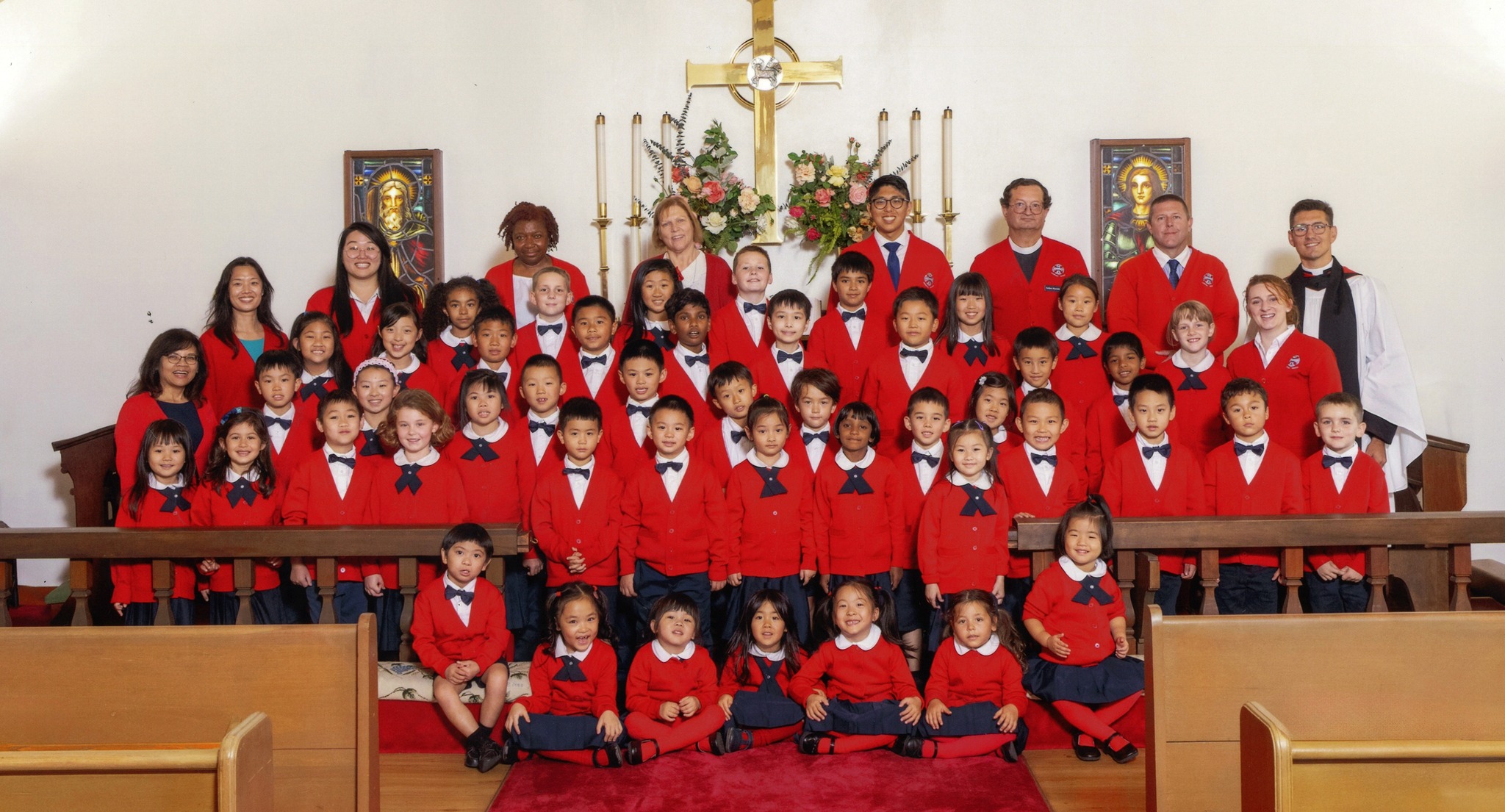
First Grade attends Chapel three days each week, giving the school week a repeated rhythm of Christian worship and formation. Students grow in familiarity with Holy Scripture, traditional Christian prayers, and hymns, and in reverent participation in worship—listening to Scripture and Christian instruction, giving thanks, and praying together.
The academic Bible curriculum deepens this further, taking students through Creation and Genesis, the patriarchs, the life and ministry of Jesus Christ, His Crucifixion and Resurrection, and the beginning of the life and ministry of St. Paul, alongside Scripture memory and basic Christian doctrine.
The Christian faith shapes the whole school day, not merely a single period on the schedule.
Courtesy, Manners, and the Habits of a Christian
First Grade students receive intentional formation in traditional Christian manners, drawing especially on the British tradition of courtesy, self-command, and consideration for others. Children practice greeting adults properly, saying please and thank you, apologizing, answering when spoken to, listening attentively without interrupting, table manners, orderly conduct in lines and public spaces, respect for teachers and classmates, and taking responsibility for their own belongings and surroundings.
Manners are not merely rules of etiquette. They are practical ways of learning self-government, respect, gratitude, and consideration for one’s neighbor.
Health & Good Habits
Alongside manners, students receive age-appropriate formation in nutrition, sleep, exercise, posture, hygiene, and the responsible, careful habits that support a healthy and orderly life.
A Year of Growing Independence
By the end of First Grade, students are no longer simply learning the basic tools of school. They are beginning to use those tools independently—to read for meaning, analyze sentences, express ideas in writing, solve increasingly complex problems, sing and pray together, study the natural and human worlds, create beautiful things, exercise their bodies, and take responsibility for careful and courteous conduct.
The aim is not simply a child who knows more, but one who is increasingly attentive, articulate, capable, reverent, courteous, and eager to learn.
Come See First Grade at Canterbury
The best way to understand First Grade at Canterbury is to see it in action. Visit a classroom and see how reading, grammar, mathematics, Scripture, hymnody, art, physical activity, Christian manners, and joyful learning come together throughout the school week.