
SECOND GRADE • GRADE 2
From Foundations to Greater Independence
Second Grade is a year in which foundational skills become increasingly independent habits of learning. Students move beyond beginning reading into deeper comprehension and literary discussion, strengthen grammar and composition, develop greater mathematical fluency, and build a broader knowledge of history, geography, science, Scripture, music, and the arts. Throughout the week, academic study is joined by Chapel, traditional prayer, choir, art, physical education, fencing, and the cultivation of Christian manners and habits.
Canterbury’s Second Grade pairs a carefully sequenced traditional academic curriculum with Shurley English grammar and formation our own faculty teach directly: sacred music, art and art history, physical education, on-campus fencing, and daily habits of Christian courtesy. The result is a year deliberately built around what a Canterbury child actually needs, not assembled wholesale from a single publisher’s catalog.
Advanced Phonics & Literary Reading
Analyzing complex sound patterns while moving into literary terms, inference, and discussion.
Shurley Grammar & Composition
Sentence analysis, the four sentence types, and paragraphs built from a real writing process.
Spelling & Vocabulary
Roughly 549 spelling words and 54 vocabulary words drawn from phonics and literature.
Mathematics through 100,000
Carrying, borrowing, multiplication, introductory division, fractions, money, and graphing.
Three Chapel Days Each Week
A steady rhythm of Scripture, prayer, and worship woven through the school week.
Choir • Art • PE • Fencing
Weekly formation in music, art, the body, and self-command.
By the End of Second Grade
Second Grade builds greater independence. Students are expected not only to know foundational skills, but increasingly to apply them thoughtfully in reading, writing, mathematics, discussion, and independent work.
Reading
Read increasingly substantial fiction, nonfiction, poetry, Scripture, maps, and instructions with fluency, vocabulary, and deeper comprehension of plot, moral, and author’s intent.
Language & Writing
Analyze sentences, apply more sophisticated grammar, write polished cursive, and compose organized paragraphs, stories, letters, and poetry.
Mathematics
Work confidently with numbers through 100,000, carrying and borrowing, multiplication and division concepts, fractions, money, and multi-step problem solving.
Knowledge & Culture
Build substantial knowledge of American history, geography, science, Scripture, literature, poetry, music, and the visual arts.
Habits & Character
Grow in attention, independence, courtesy, perseverance, physical confidence, reverence, and responsibility for increasingly complex work.
Reading with Understanding and Judgment
Second Grade is no longer simply about becoming able to read—it is about learning to read closely and understand what a text is doing. Students continue applying phonics with growing speed and accuracy while developing oral and silent reading, fluency, phrasing, expression, punctuation, appropriate pace, and comprehension.
Second Grade students increasingly learn to ask not only “What happened?” but “Why did it happen, what does it mean, and what evidence supports my answer?”
Students move into real literary thinking: identifying a story’s title, author, main character, main idea, setting, plot, and moral; discussing an author’s intent; and reasoning through cause and effect, problem and solution, prediction, comparison, and textual inference. They also learn to read practical material such as maps, charts, graphs, recipes, and posted instructions.
The reading program draws on classic literature, historical fiction, nonfiction, folktales, biography, poetry, and Scripture, including works by authors such as Beatrix Potter, A. A. Milne, Robert McCloskey, Hans Christian Andersen, Robert Louis Stevenson, and Nathaniel Hawthorne.
Mastering the Structure of Words
Second Grade brings Canterbury’s intensive phonics sequence toward culmination. Students deepen their ability to analyze complex vowel and consonant patterns, distinguish alternate spellings of the same sound, recognize silent letters, divide words into syllables, identify root words, and apply prefixes, suffixes, and spelling rules.
Rather than memorizing every pattern in isolation, students learn why one spelling is chosen over another—why a word ends in -ck rather than -k, or why a suffix changes the spelling of the word it is added to. Compound words, contractions, and correct use of number words, months, and days round out the year’s word study.
Spelling & Vocabulary
Second Grade spelling becomes a more independent subject in its own right. Over the course of the year, students work through roughly 549 spelling words and 54 vocabulary words, organized by phonetic pattern and closely tied to the phonics and reading sequence.
Spelling becomes increasingly connected to vocabulary, word structure, and written expression.
Students spell words with increasingly complex phonetic patterns, study common misspellings and abbreviations, distinguish homonyms, and learn to use new vocabulary correctly in context, both in speaking and in writing.
Learning to Analyze the English Sentence
Second Grade continues Shurley English as Canterbury’s primary grammar method, building on the oral, participatory instruction begun in First Grade. Students continue learning through grammar jingles, oral recitation, the Question-and-Answer Flow, sentence classification, teacher-led analysis, and repeated oral and written practice.
Students increasingly identify and use subjects and predicates, nouns, verbs, adjectives, adverbs, articles, and other concepts appropriate to this level, along with complete sentences, sentence types, capitalization, and punctuation. The Grade 2 sequence reinforces declarative, interrogative, imperative, and exclamatory sentences; complete and simple subjects and predicates; possessives and plurals; contractions; and synonyms, antonyms, and homonyms—concepts Canterbury folds into its Shurley instruction rather than teaching as a separate, competing grammar program.
Grammar is not memorized in isolation. Students repeatedly analyze real sentences until the structure of English becomes familiar.
Writing with Greater Independence
Handwriting is now expected to become an increasingly automatic tool for academic work. Students continue refining letter formation, size, spacing, slant, and smooth connections, working toward neat, legible cursive without the help of dotted guides.
Composition grows accordingly. Students write complete sentences, paragraphs, stories, journal entries, historical and Bible-related compositions, friendly and persuasive letters, original poetry, and acrostics, increasingly incorporating a clear beginning and concluding sentence, sequence, character, setting, plot, and moral. Canterbury continues the same writing process introduced in First Grade: Gather, Plan, Draft, Revise, Check, Share.
In Second Grade, students increasingly move from writing a correct sentence to organizing several sentences around a coherent idea.
Poetry Worth Remembering
Second Grade continues Canterbury’s practice of memorizing and reciting poetry, working through eight lyrical poems over the course of the year. Memorization builds memory, vocabulary, rhythm, and expressive speaking, while reciting before the class builds volume, poise, and confidence.
This work joins Canterbury’s larger culture of committing good words to memory—Scripture, traditional prayers, and hymns—so that children carry a store of beautiful language with them well beyond the classroom.
From Arithmetic Fluency to More Abstract Thinking
Second Grade mathematics extends number understanding from 1,000 into numbers as large as 100,000, including place value through the hundred-thousands, comparison, skip counting, and Roman numerals. Addition develops into carrying through increasingly large place values and three- and four-digit problems, while subtraction develops into borrowing across multiple digits, including problems involving zeros.
Multiplication is introduced through the tables for 0, 1, 2, 3, 5, and 10, and division is formally introduced through grouping and the corresponding division tables. Students also work with fractions and mixed numbers, comparing fractional parts and finding the fractional part of a whole number.
Practical mathematics runs throughout the year: money with dollars, cents, and decimal notation; time to one-minute intervals and elapsed time; length, weight, capacity, and temperature in both standard and metric units; bar, line, and circle graphs; and geometry, including plane and solid figures, perimeter, symmetry, and locations on a coordinate plane.
Second Grade mathematics increasingly asks students not simply to calculate, but to decide which operation or mathematical idea a problem requires.
Following the Story of America
Second Grade makes American history considerably more chronological and substantial. Students follow the broad sweep of the American story: Native American cultures, the Separatists and Pilgrims, the Mayflower and Plymouth, colonial life, trades, and schools, George Washington, the Declaration of Independence, and the American Revolution.
The story continues forward into the young republic and beyond: national symbols and holidays, the War of 1812, westward expansion and the pioneers, the Underground Railroad, the sectional conflict and Abraham Lincoln, the railroads, cattle ranching and the American West, immigration, American inventions, and notable Americans in science, art, athletics, military service, and space exploration.
Geography work builds a real framework for this story: compass directions, the seven continents and five oceans, hemispheres, the equator and poles, all fifty states and the regions of the United States, and the major rivers, mountains, and landforms of North America.
Second Grade begins to give children a chronological framework for understanding how the United States developed.
Investigating God’s World
Second Grade science becomes substantially more analytical, building on the careful observation and wonder cultivated in First Grade. Students study several areas of God’s creation, learning to observe, ask questions, predict, experiment, gather data, and share conclusions.
The Human Body
Students study the five senses, the skeleton and muscles, the nervous system, digestion, the heart and circulation, the lungs, and the teeth—learning to see the body as a marvel of God’s design.
Plants
Students examine the structures of a plant—stems, leaves, roots, and seeds—and study how leaves make food through photosynthesis at an age-appropriate level, how roots draw nutrients from the soil, and how seeds travel and take root.
Animals and Their Habitats
Students study habitats and the ecosystems they support, including oceans, ponds, forests, savannas, and rainforests, along with predator-and-prey relationships, adaptation, and food chains.
Scientific Investigation
Students are introduced to an age-appropriate scientific method—observing, asking questions, predicting, experimenting, gathering data, and sharing conclusions—along with the basic tools and safety habits of a working scientist.
Matter, Energy, Air & Weather
Students study solids, liquids, and gases; forces such as gravity and magnetism; simple machines; and the atmosphere, water cycle, and weather, including storms and how meteorologists predict them.
Learning to Sing with Skill and Understanding
Second Grade students have weekly choir, singing traditional hymns and sacred music in English, Latin, and German. Instruction continues to develop pitch matching, solfège, rhythm, breath, posture, diction, following a conductor, memorization, and singing together as an ensemble.
As students grow, they are expected to become more attentive to accurate pitch, clear diction, and ensemble singing—bringing greater skill to the same act of worship and community that began in Kindergarten and First Grade.
Second graders learn that singing well requires the same things worship does: attention, discipline, memory, and joy.
Learning to See, Understand, and Create
Second Grade continues weekly art, combining studio work with art history. Students are introduced to major artists, works, and historical periods and traditions, including age-appropriate study of the Baroque, Romantic, and Modern periods, among others selected during the year.
Students increasingly learn to notice line, color, shape, composition, light, texture, perspective, and style in the works they study, while studio work develops drawing, painting, color theory, shading, mixed media, paper construction, and three-dimensional work.
Children should learn not only to make art, but to look carefully and intelligently at the artistic inheritance of the past.
Strength, Fitness, and Physical Confidence
Second Grade continues regular Physical Education, emphasizing cardiovascular activity, fitness, coordination, stamina, movement, age-appropriate strength, games, teamwork, and sportsmanship.
En Garde: Fencing at Canterbury
All Second Grade students continue receiving fencing instruction on campus through our partnership with Maximum Fencing Club in Los Altos. Students build on the foundations begun in earlier grades, growing in stance, footwork, balance, coordination, distance, attention, self-control, quick decision-making, and respect for an opponent.
Faith Woven Through the Week
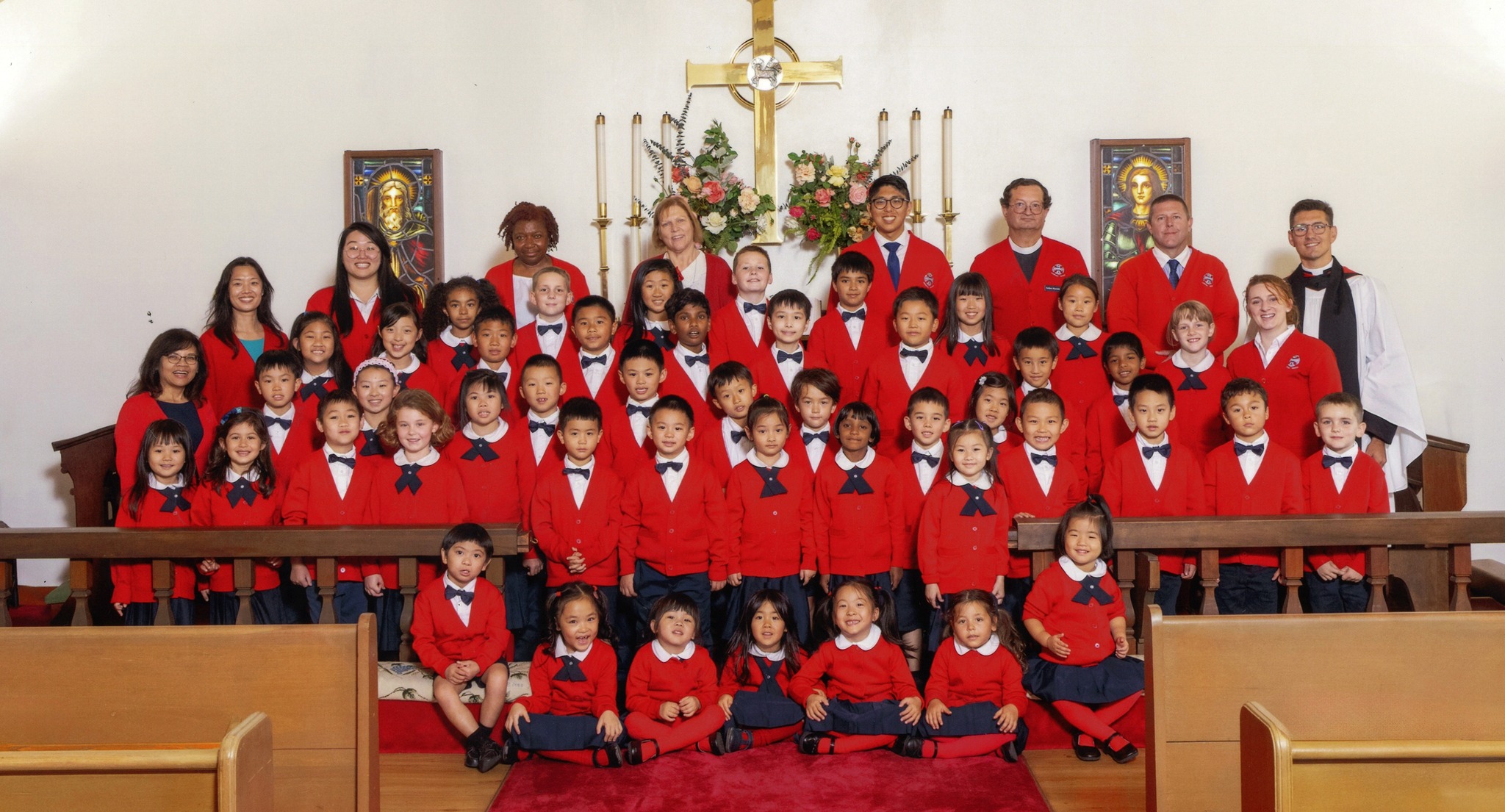
Second Grade attends Chapel three days each week, continuing the steady rhythm of Christian worship and formation begun in earlier grades: Scripture, traditional Christian prayers, hymns, reverent worship, thanksgiving, listening, and corporate prayer.
The academic Bible curriculum deepens further, taking students through the lives of Moses, Joshua, Judges, Ruth, and Jonah, along with the Nativity, Crucifixion, and Resurrection—using these biblical lives to discuss choices, virtues, consequences, trials, and faithfulness, alongside Scripture memory, doctrine, and prayer.
The Christian faith shapes the whole school day, not merely a single period on the schedule.
Courtesy, Self-Government, and Christian Manners
Second Grade continues Canterbury’s formation in traditional Christian manners, drawing especially on the British tradition of courtesy, self-command, and consideration for others. Students grow toward greater independence: speaking courteously, greeting adults, listening without interrupting, apologizing properly, showing patience, practicing good table manners, treating servers and workers courteously, and helping without constant prompting.
Manners are practical exercises in self-government, gratitude, and love of neighbor.
Health & Good Habits
Alongside manners, students receive age-appropriate formation in nutrition, exercise, rest, hygiene, safety, and the responsible, careful habits that support a healthy and orderly life.
A Year of Deepening Independence
Second Grade is a transition from foundational skill-building toward increasingly independent academic work. Students read more thoughtfully, analyze language more precisely, write more substantial compositions, calculate with larger numbers, investigate the natural world, follow the broad sweep of American history, and take increasing responsibility for their conduct, worship, physical development, and work.
The goal is a student who is becoming more articulate, capable, observant, disciplined, courteous, and intellectually curious.
Come See Second Grade at Canterbury
Visit Canterbury and see how strong academics, Christian worship, traditional grammar, literature, mathematics, art, music, physical training, fencing, and thoughtful habits come together in a Second Grade classroom.