
A Strong Foundation for a Lifetime of Learning
At Canterbury School, our Kindergarten program (K5) lays a joyful, structured, and Christ-centered foundation in reading, writing, mathematics, Bible, science, and cultural literacy.
The Canterbury Difference
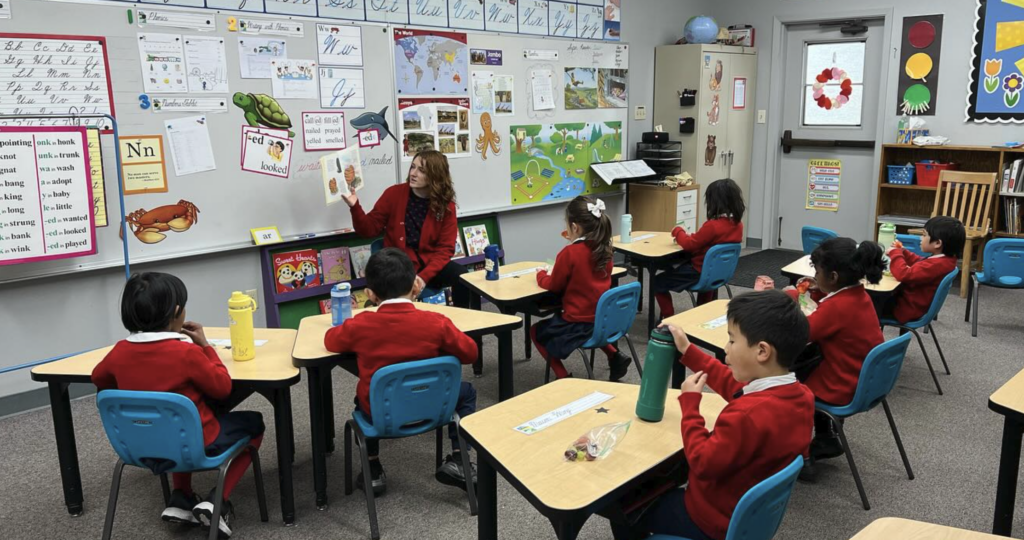
Kindergarten at Canterbury is a limited class of just 16 students, allowing for personal attention, strong classroom culture, and close partnership with families. Our students wear uniforms, cultivating order, unity, and a sense of purpose. The school day runs from 8:15 a.m. to 3:00 p.m., providing a full and unhurried academic experience. Extended care is offered until 5:30 p.m.
Our classrooms are intentionally free from student technology. Instead of screens, children engage directly with books, cursive handwriting, discussion, memorization, and hands-on learning. Kindergarten at Canterbury is structured yet joyful, academically serious yet age-appropriate, rooted in phonics rather than guessing strategies, integrated with Scripture and character formation, and designed to prepare students for the rigor of our classical grammar program.
By the end of Kindergarten, our students are reading, writing in cursive, solving math problems, memorizing Scripture, and confidently reciting poetry. We believe strong foundations build confident learners.
Language Arts: Phonics & Reading
Reading is the heart of our Kindergarten year. By the end of K5, students master all consonants and short and long vowel sounds, blend consonant-vowel combinations, decode one- and two-vowel words, and learn 49 special phonics sounds including blends, digraphs, and diphthongs. They apply foundational phonics rules such as the c/k rule, silent e patterns, consonant doubling, and more. Students read sight words such as the, a, I, to, do, and of, and progress to complete sentences and short stories with comprehension.
Students move through a carefully sequenced set of readers, developing accuracy, expression, fluency, proper volume, and attentiveness to punctuation. Our advanced readers progress further into prefixes, suffixes, and more than 130 special sounds. Kindergartners are often amazed at how quickly they move from letter sounds to reading full stories.
Cursive-First Handwriting
Our Kindergarten students learn cursive alongside phonics instruction. They develop proper pencil grip and posture, correct letter formation, consistent slant and spacing, and write their first name, blends, words, and simple sentences. Fine motor control and neatness are emphasized from the beginning.
Poetry and Language Development
Students memorize and recite thirteen classic poems, including works by Robert Louis Stevenson and Christina Rossetti. Through poetry, students build vocabulary, develop rhythm and expression, practice public recitation, and grow in confidence. Language development includes learning opposites and positional words, forming complete sentences, using descriptive language, solving riddles, categorizing items, and strengthening logical thinking skills.
Mathematics
Kindergarten mathematics at Canterbury is structured and thorough. Students count to 100 by ones, fives, tens, and twos; recognize and write numbers to 100; spell number words one through ten; and build foundational place value understanding. Students add and subtract, solve word problems, tell time on a traditional clock (also to the hour, half hour, and quarter hour), recognize coins and money combinations, understand the concept of fractions, and identify basic geometric shapes. Written and oral assessments are given throughout the year to reinforce mastery.
Science and Social Studies
Our science program introduces students to the wonder of God’s creation. Units include the five senses, weather and seasons, seeds and plant growth, animals including farm and zoo animals, insects, birds and reptiles, and the seashore. Students participate in hands-on activities, drawing, coloring, and guided observation exercises.
Kindergarteners begin cultural literacy and historical awareness through the study of community helpers such as firefighters, doctors, pastors, teachers, and farmers. Students are introduced to important figures in American history including Christopher Columbus, the Pilgrims, George Washington, Abraham Lincoln, George Washington Carver, and Pocahontas.
They learn about American symbols such as the U.S. flag, the Statue of Liberty, the Liberty Bell, Mt. Rushmore, and the bald eagle. Students also explore twelve countries around the world and are introduced to continents, oceans, and basic geography.
Bible, Character, and Patriotism
Bible is central to our Kindergarten year. Students study Creation and the Genesis narratives, the life of Christ, the Crucifixion and Resurrection, missionary stories, and the First Thanksgiving. They memorize Scripture verses and participate in doctrinal drills that introduce foundational truths about the Bible, God, sin, salvation, and Heaven.
Students learn hymns, patriotic songs, and character-building songs. They develop rhythm, pitch awareness, coordination, and joyful participation through regular singing.
Arts and Crafts
Through structured art projects, students build fine motor skills, listening skills, and creativity. Projects connect to seasons, Scripture, history, phonics, and mathematics, reinforcing academic learning through hands-on experience. They also have a weekly art class with an on-campus art instructor.
Developmental Skills
Kindergarten strengthens hand-eye coordination, visual perception, listening skills, logical thinking, sequencing, map skills, and introductory graphing. Students also grow in character traits such as kindness, courtesy, obedience, truthfulness, self-control, respect, diligence, and generosity.